What you need to know about volatility: the stock market is squiggly.
Welcome to the tenth post of The Invested Counsel—thoughts about financial planning for young lawyers.
One of the main sources of ideas for The Invested Counsel is discussions I have with my clients. And when I explain how my clients should think about their investments, the concept of volatility comes up a lot. But I’m usually reluctant to use the word “volatility,” since it sounds intimidating and confusing, even to lawyers who are used to intimidating and confusing terminology. So here is how I explain the concept without using the “V” word.
(1) The stock market is squiggly. It goes up and down all over the place.
(2) In the short term, you don’t know which way the stock market will squiggle.
(3) But in the long term, the stock market will squiggle up.
Visualizing the squiggliness of the stock market.
Some pictures may be helpful to understand how this works.
I’m writing this on August 10, 2026. Below are charts showing how the S&P 500 (which is an index, or just a list of 500 of the largest public companies in the United States) performed over different periods of time. Don’t worry about the numbers; just look at the squiggles.
Today. Here’s how it did today. As you can see, it was pretty squiggly. It went up and down throughout the day, until finally it went down for the day.

Five Days. Here’s how it did over the last five days. Again, very squiggly.

One Month. Here’s how the S&P did over the last month. Again, very squiggly.

Six Months. Here’s how the S&P did over the last six months. Again, very squiggly.

One Year. Here’s how the S&P did over the last year. Again, squiggly.

Five Years. Here’s how the S&P 500 did over the last five years. Still squiggly, but less so.

30 Years. Finally, here’s the chart going all the way back to 1996. Not nearly as squiggly.
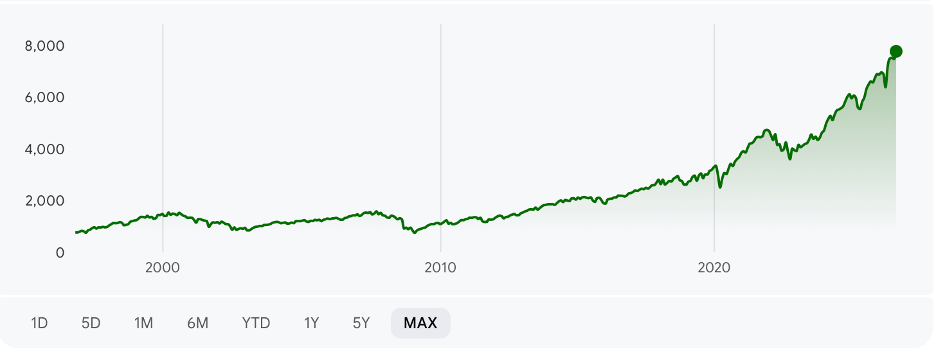
As you pull back over time, the squiggliness of the market disappears. Remember that this last chart includes the dot-com crash, the Great Recession, Covid, and everything else that’s happened in the last 30 years. Those huge events don’t register as much over the long term.
Why the squiggliness matters.
As the last chart shows, over the long term the market goes up. But in the short term, the market is squiggly. And that means it can squiggle down a lot. In 2008, the S&P 500 squiggled down 37%. In 2022, it squiggled down 18%. That is a lot, and that is no fun.
But in order to get the good side of the stock market (going up over the long term), you need to accept the squiggliness. Finance writer Morgan Housel says that “volatility is the price of admission.” I’ll modify that slightly: squiggliness is the price of admission. What that means is that if you want to make money in the stock market, you have to accept the squiggliness. That’s just the deal.
Or: How I Learned to Stop Worrying and Love the Squiggliness
There is no good way to avoid the squiggliness, and at the same time make good money in the market over the long term. But there are things that you can do to help yourself handle with the squiggliness of the market.
Have a financial plan that can deal with the squiggliness. When you are figuring out how to plan out your money, you need to figure out what money can be left to squiggle, and what money cannot. If you have money for long-term goals (e.g., college, retirement, etc.) that can be left to squiggle with the market, then you should let it. If you need the money in the short term, then you cannot let it squiggle, because it could squiggle down very quickly just when you need it.
Have a financial plan that can deal with your reaction to the squiggliness. Some people are fine accepting that the market is squiggly. Some people are not. And some people (i.e., most people) are in the middle. It’s better to have an honest and accurate sense of your ability to deal with the squiggles, and develop a plan that will actually work for you. You can’t say when things are good that you can accept squiggliness, and then change your mind when things are bad. You need to stick with it through the good and the bad. Know thyself.
In a future post, I’ll explain how you can use your asset allocation (i.e., the decision of how much you invest in different possible investments) to address your ability to deal with the squiggliness of the market.
Improve your ability to deal with squiggliness. Your ability to deal with the squiggliness of the market is under your control to some extent. Here are two complementary things that you can do to help you increase that capacity to deal with the squiggliness of the market (and thus increase your ability to make money in the market over the long term).
(1) Learn about the market. The more you understand the market, the more you’ll understand why it squiggles. (Note that you won’t be able to predict when it will squiggle—no one can do that—but you can understand why it is so squiggly.) That will help you deal with the drops when they come, because they will come.
As I mentioned in last week’s post, in which I explained how I’m trying to teach my seven-year-old about investing, I introduced the concept of “volatility immunotherapy.” The idea is that if I expose my daughter to little bits of squiggliness in the market when she’s young, she’ll understand that it is just part of how it works when she’s older and is handling her own money. You can try the same thing on yourself; even if you’re not young, it’s good to have at least some sense of the market over the long term, to develop that same sort of immunity.
What does “some sense of the market” mean? I think you should generally know if things have been roughly up or roughly down over the last few months and the last few years. If you know that, that’s probably enough. Once you have a good plan in place, I think looking at the performance of your investments for a couple of minutes once a month is sufficient to do the trick.
(2) Ignore the market. Once you are getting “some sense of the market,” everything else is pretty much irrelevant. You don’t need to watch CNBC or read the Wall Street Journal. You don’t need to follow what the Federal Reserve is doing, or the latest employment numbers. You don’t need to worry about how a particular company or industry is doing. That stuff doesn’t matter to you, so feel free to ignore it.
That’s all for now. Have a wonderful week.
***
The Invested Counsel is now on Substack. If you would like to subscribe and get an emailed version of each post sent to you, go to https://substack.com/@theinvestedcounsel and sign up.